What makes great design work: The roles of the art director, designer, and copywriter
From Check-In to Check-Out: The AI Touchpoint Playbook That Lifts Guest Scores, Earns Better Reviews and Gives Your Team Time Back
Viet Anh Nguyen
Web Development Manager
The AI hotel guest experience is no longer a future concept — it is happening right now, across every stage of the guest journey.
very marketing touchpoint a guest has with your hotel— from the booking confirmation email to the post-stay survey — is a chance to impress them, retain them, and earn their public recommendation. AI now makes it possible to get every one of those moments right, consistently, without adding headcount. Here is exactly how.
Most hotels focus their AI conversation on one or two areas: maybe a chatbot on the website, or automated review requests. But the real opportunity is bigger. It runs across the entire guest journey — and every marketing touchpoint within it, and the hotels exploiting it fully are pulling ahead on every metric that matters — satisfaction scores, review volume, direct bookings, and revenue per available room.
This article maps every major guest touchpoint, tells you exactly what AI can do at each one, and shows you how to start. By the time you reach the end, you will have a clear picture of where your hotel is leaving value on the table — and how to pick it up.
WHY THIS MATTERS NOW
A 2024 study by Salesforce found that 73% of customers expect companies to understand their needs before they articulate them. In hospitality, that expectation is even higher. AI is the only scalable way to meet it.
Five Stages of the AI Hotel Guest Experience
The guest journey can be divided into five stages. Each one carries specific friction points. And each one has AI solutions available today — not in some future roadmap, but live, tested and accessible to independent hotels right now.
📬 STAGE 1: PRE-ARRIVAL
Turn Booking Confirmation Into Your First Upsell
The gap: Most booking confirmations are transactional receipts. They confirm the dates and sign off. That is a missed relationship moment — and a missed revenue moment. The guest is at peak excitement right after booking. That is the perfect time to engage.
What AI does: This is the AI hotel guest experience in action — personalising every pre-arrival touchpoint based on what you already know. It can send a sequenced series of emails — a warm welcome on day one, a room upgrade offer three days before arrival, a tailored itinerary two days out, and a check-in reminder the morning of. Each message is generated and timed automatically, with personalisation tokens that pull in the guest’s name, room type, and booking preferences.
EXAMPLE PRE-ARRIVAL MESSAGE“Hi Sarah, your Superior Room with garden view is ready and waiting. Before you arrive, we wanted to let you know our spa has availability on Saturday afternoon — a 60-minute massage for two is €95, and it books out fast on weekends. Want us to reserve it? Just reply yes and we’ll add it to your stay.”
🏨 STAGE 2: ARRIVAL & CHECK-IN
Remove Friction at the Front Door
The gap: Guests arriving after a long journey want to get to their room. A queue at reception — even a short one — sets the wrong tone. More importantly, front desk staff are often so occupied with check-in logistics that they miss the human connection that makes a hotel stay memorable.
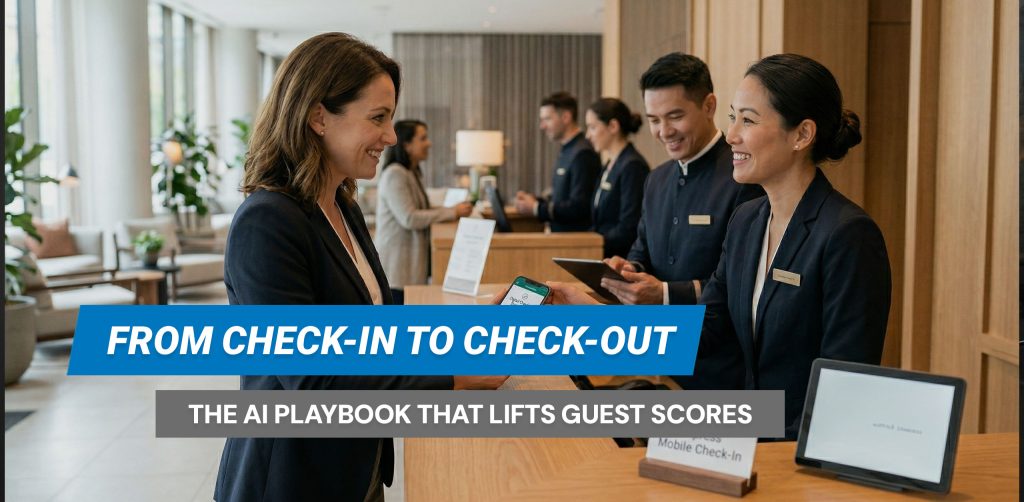
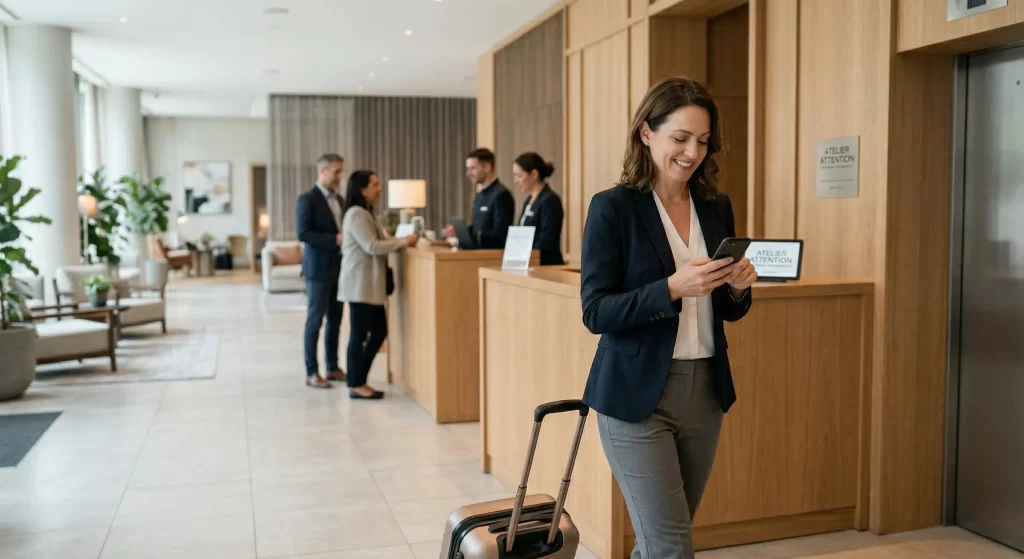
What AI does: AI handles the administrative layer of check-in digitally, before the guest arrives. Mobile check-in flows powered by AI can confirm room readiness, collect ID documents, process payment, and deliver a digital room key — all via a link in the pre-arrival email. When the guest arrives, the front desk interaction becomes a genuine welcome rather than a form-filling exercise. AI also handles common check-in questions via a WhatsApp or SMS chatbot: parking, Wi-Fi, restaurant hours, luggage storage.
REAL IMPACTHotels using digital pre-check-in report front desk queue times reduced by up to 60%, while guest satisfaction scores for arrival experience increase by an average of 18 percentage points. Your team gets to do the job they were hired to do: make people feel welcome.
⭐ STAGE 3: DURING THE STAY
Respond Instantly to Every Request, At Any Hour
The gap: In-stay is where the AI hotel guest experience wins or loses reviews — and where most hotels are still leaving value on the table. A guest with an unresolved complaint — a noisy room, a broken hairdryer, a slow response to a dinner reservation request — almost always documents it publicly. And most complaints are not about the problem itself. They are about how long it took to be heard.
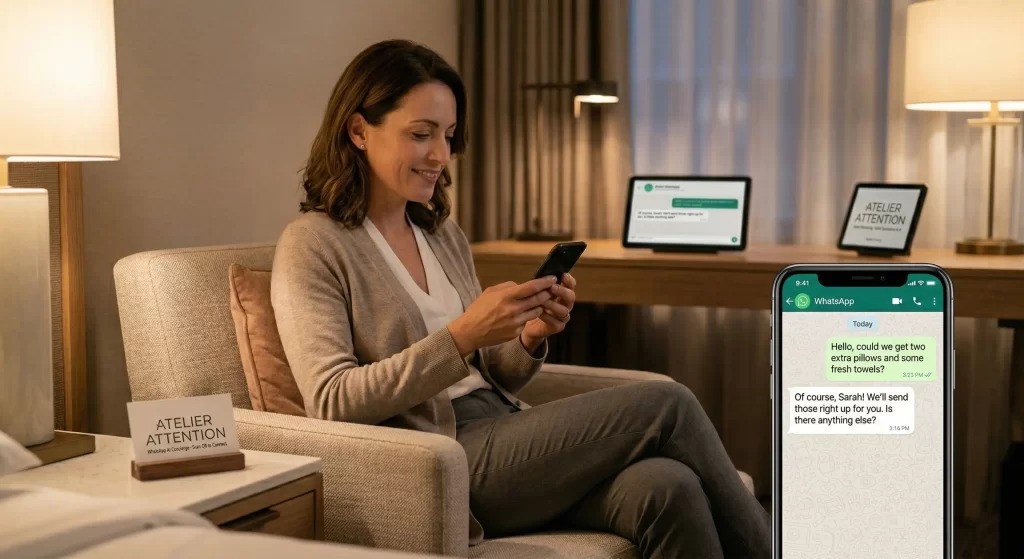
What AI does: AI concierge systems, typically deployed via WhatsApp, SMS, or in-room tablet, give guests an instant, always-on channel to make requests, ask questions, and raise concerns. The AI handles straightforward requests (extra pillows, pool towels, wake-up calls, restaurant bookings) automatically and escalates complex or emotional issues to a human immediately. Crucially, it logs every interaction so your team has full context when they respond. It also enables proactive outreach: an AI message at check-in day two asking “How is your stay going so far?” catches problems before they become complaints.
WHAT THIS LOOKS LIKE IN PRACTICE Guest messages at 11pm: “The air conditioning in our room is very loud.” AI responds instantly: “We’re sorry about that. I’ve flagged this to our night manager who will be with you within 10 minutes. Can I offer you a complimentary drink at the bar while you wait?” — logged, escalated, and a goodwill gesture offered, all automatically.
🗳️ STAGE 4: CHECK-OUT
Make the Last Impression as Good as the First
The gap: Check-out is the most underrated marketing touchpoint in the entire guest journey. It is the last thing a guest experiences before they form their final opinion of the stay — and before they decide whether to write a review. Most hotels treat it as a billing formality. That is a mistake.
What AI does: AI streamlines the operational side of check-out (express checkout via mobile, automated bill delivery, digital receipt) while simultaneously priming the guest to advocate for you. An AI-generated check-out message sent the morning of departure can thank the guest by name, summarise highlights of their stay, invite direct feedback, and — if sentiment is positive — include a direct link to your preferred review platform. Timing is everything: guests asked for a review within the hour of departure are significantly more likely to leave one.
THE CHECK-OUT MESSAGE FORMULA“Good morning, James. We hope you had a wonderful three nights with us. Your express checkout is ready — no need to stop at reception. Your invoice is attached. If you have a moment, we’d love to hear about your stay. And if you enjoyed it, a quick Google review means the world to our small team. [Leave a review →]”
🔄 STAGE 5: POST-STAY
Turn One Stay Into a Lifetime Relationship
The gap: Most hotels send a survey. Most guests ignore it. The post-stay window is the most underused part of the AI hotel guest experience — and one of the highest-value marketing moments in hospitality, and almost no hotel uses it well.
What AI does: AI makes post-stay communication personal and purposeful. Rather than a generic survey blast, it sends a personalised follow-up based on what the guest actually did: a family with children gets a message about your school holiday packages; a couple who visited the spa gets early access to a weekend wellness offer; a solo business traveller gets a corporate rate for their next trip. AI also monitors incoming reviews in real time and generates personalised responses within minutes — publicly thanking reviewers, acknowledging issues with specificity, and reinforcing your brand voice at scale.
THE RETENTION NUMBERS Guests who receive a personalised post-stay offer are 3x more likely to book again than those who receive a generic survey. Automated, personalised review responses increase the volume of future reviews by an average of 22% — because guests see that their feedback was genuinely read.
You do not need to build your entire AI hotel guest experience at once. Start where your current pain is greatest and build from there. Here is a practical 30-day sequence:
1
WEEK 1: AUDIT YOUR CURRENT TOUCHPOINTS
Map every marketing touchpoint and automated message your hotel currently sends — booking confirmation, pre-arrival, check-out, post-stay survey. For each one, ask: Is this personal? Does it offer any value beyond information? Does it include a next step? Most hotels will find three or four completely generic messages that can be immediately improved.
2
WEEK 2: IMPLEMENT PRE-ARRIVAL AUTOMATION FIRST
Pre-arrival is the highest-ROI starting point. Set up a three-email sequence: a warm welcome (sent immediately after booking), an upsell offer with a deadline (sent five days before arrival), and a practical arrival guide with your check-in link (sent the morning of arrival). Use an email automation tool with AI personalisation — Mailchimp, ActiveCampaign, or HiJiffy are all viable options for hotels.
3
WEEK 3: LAUNCH AN IN-STAY MESSAGING CHANNEL
Connect a WhatsApp Business account or SMS platform to your front desk workflow. Configure AI auto-responses for the ten most common guest requests at your property (these are almost always the same: Wi-Fi password, extra towels, late checkout, restaurant recommendation, taxi request). Test internally for two days before going live with guests.
4
WEEK 4: AUTOMATE YOUR CHECK-OUT AND REVIEW FLOW
Set up an automated check-out message timed for 8am on departure day. Include the express checkout link, the invoice, a personal thank-you, and a review link. Use a tool like Revinate, TrustYou, or even a simple Zapier workflow to trigger the message automatically. Track review volume over the following four weeks. You will see a measurable lift.
A NOTE ON AI TOUCHPOINTS AND THE HUMAN TOUCH
The goal of AI in hospitality is never to replace warmth. It is to protect the time your team needs to deliver it. When AI handles the administrative, repetitive and out-of-hours work, your people are free to do what no technology can: make a guest feel genuinely seen. The best hotel AI implementations are invisible to the guest — they just notice that everything runs smoothly.
Hotels that build a complete AI hotel guest experience typically report measurable improvement in three areas within 60 to 90 days:
Review volume increases by 20 to 35% as guests are asked at the right moment in the right way
Review scores improve by 0.2 to 0.4 points on Google and TripAdvisor as complaints are resolved before checkout
Upsell revenue from pre-arrival and in-stay AI messages typically adds 8 to 15% to ancillary revenue per occupied room
Front desk staff report significantly higher job satisfaction as transactional tasks decrease and guest interaction improves
None of these results require a technology overhaul. They come from applying existing, accessible AI tools at the right moments in a journey your hotel is already running. The infrastructure is there. The guests are ready. The question is whether you are using it.
Want Help Mapping Your Hotel’s AI Touchpoints?
Atelier ATTENTION builds the AI hotel guest experience for hotels that want better reviews, higher revenue and a team that has time to breathe. that want better reviews, higher revenue and a team that has time to breathe
Schedule your free consult
Schedule a free 45-minute video call with us to discover how Atelier ATTN. (ATTENTION) can enhance your marketing efforts. Learn how our team of talented and motivated professionals in Vietnam can provide exceptional value with competitive pricing.