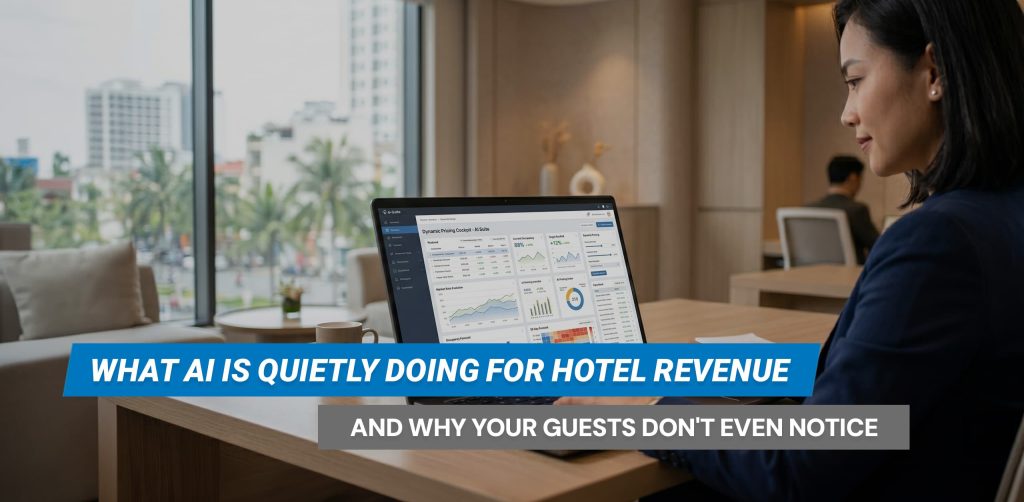
The hotels winning right now are not the ones running the loudest campaigns.
They are not posting three times a day on Instagram or spending the most on Google Ads. They are using AI for hotel revenue — making small, deliberate changes to how they price rooms, respond to guests, and show up in search — and AI is doing most of the work.
The best part? Their guests have no idea.
That is not a failure of communication. It is the point. When AI is working properly inside a hotel, the guest simply experiences a faster response, a better-priced room, and a more personal stay. They do not need to know how it happened. They just remember how it felt.
| The sign of well-implemented AI for hotel revenue is not a flashy demo. It is a guest who simply had a great experience. |

Three Areas Where AI Is Already Moving the Needle
Most conversations about AI in hospitality focus on the future — robots, voice-activated rooms, AI concierges. Interesting, certainly. But the real AI for hotel revenue gains are happening right now, in three much quieter areas.
1. Pricing That Works While You Sleep
Dynamic pricing is not new. AI for hotel revenue has just made it dramatically better.
Traditional hotel revenue management meant updating rates based on a handful of predictable signals — weekends, school holidays, local events. AI-powered revenue management systems do something far more sophisticated: they read dozens of signals simultaneously, in real time, and adjust your rates accordingly.
Competitor pricing. Booking pace on your own website. Search demand on OTAs. Local event calendars. Historical booking windows for each room type. Weather patterns that affect travel behavior in your market.
For most properties, this means rates that are more accurate, more competitive, and more profitable — without your hotel revenue management team spending evenings staring at spreadsheets.
The guest experience? Completely unchanged. They see a rate that feels fair. You see a RevPAR that keeps climbing.
2. Guest Communication That Converts
Speed is where AI for hotel revenue makes its first visible impact.
When a potential guest sends an inquiry — whether through your website, WhatsApp, Facebook Messenger, or email — the window between interest and decision is short. The faster you respond, the higher your conversion rate. Not slightly higher. Significantly higher.
AI-powered communication tools now handle this window. Personalized responses go out immediately. Follow-ups happen automatically. Upsell offers — a room upgrade, an early check-in, a spa package — are timed to arrive at exactly the right moment in the booking journey.
And here is what makes this particularly powerful for direct bookings: when you control the communication channel, you control the relationship. You are not competing with fifteen other properties on an OTA page. You are having a direct conversation with a guest who has already shown interest in your property.
For hotels working to grow AI direct bookings and reduce OTA commissions, this is one of the most immediately impactful areas to invest in. We explored the broader strategy behind this in detail — here is how to reduce OTA dependency and drive more direct bookings.
3. How Guests Find You — Before They Think About Booking
This is where AI for hotel revenue is changing fastest — and where the gap between early movers and everyone else is widening most quickly.
For years, hotels optimized for Google. Keywords, meta descriptions, page speed. That still matters. But something significant is happening alongside it.
More and more travelers are starting their search not with a Google query, but with a conversation. They ask an AI assistant — ChatGPT, Copilot, Gemini, or any number of emerging tools — something like: “Find me a boutique hotel in Bangkok with a rooftop pool, late check-in, and good reviews from business travelers.”
The AI does not show a list of links. It produces a recommendation. And if your hotel is not represented clearly and accurately across the sources that AI reads — your website content, your Google Business Profile, your review data, your structured markup — you may simply not appear.
| IDC predicts that by 2030, 30% of travel bookings will be executed by AI agents. That shift is already beginning. The hotels getting ahead of it now will benefit most as it accelerates. |
This is one reason that local visibility and online presence work has become more important, not less, in an AI-powered search environment. A clean, well-structured online presence is no longer just good marketing — it is how you get found.
Our local SEO for hotels service is built specifically around this — making sure your property shows up in the right places, for the right travelers, at the right moment.

Why Guests Don’t Notice — and Why That Is a Good Sign
The sign of well-implemented AI is not a flashy demo. It is a guest who simply had a great experience.
They got a fast response to their inquiry. The rate they paid felt right for the value they received. The upgrade offer arrived at just the right moment. Check-in was smooth and personal. They will leave a good review. They convert into AI direct bookings next time — without an OTA in the middle.
None of that happens because a sign in the lobby says “this hotel uses AI.” It happens because the right things were made faster, more consistent, and more personal — invisibly.
The Competitive Window Is Open — but It Is Closing
Independent hotels and small hotel groups have an advantage that chains often do not: they can move quickly.
A boutique property or an independent owner-operated hotel can make decisions and implement changes in weeks. A chain with hundreds of properties may need months — sometimes longer — to roll anything out. That agility is genuinely valuable right now.
A March 2026 BCG report found that hotels using hotel AI tools are already delivering measurable gains across revenue management, operational costs, and guest experience. The early adopters are not waiting to see what happens. They are building the advantage while it is still available.
The hotels that benefit most from AI for hotel revenue in the next twelve months will not be the biggest ones. They will be the ones that moved first.

What This Means for Your Property
You do not need a large budget to start with hotel AI tools. You do not need a dedicated AI team.
What you need is clarity on which AI for hotel revenue area — pricing, communication, or discoverability — is costing your property the most revenue right now. That is the right place to begin.
At Atelier ATTENTION, our hospitality marketing work is built around exactly this kind of focused, results-driven strategy. We help hotel marketing teams identify where the real gaps are — and build the approach around closing them.
If this is something you want to explore for your property, our contact form is the right place to start. No pressure, no pitch — just a conversation about where AI could quietly make the biggest difference for your hotel.

Schedule your free consult
Schedule a free 45-minute video call with us to discover how Atelier ATTN. (ATTENTION) can enhance your marketing efforts. Learn how our team of talented and motivated professionals in Vietnam can provide exceptional value with competitive pricing.