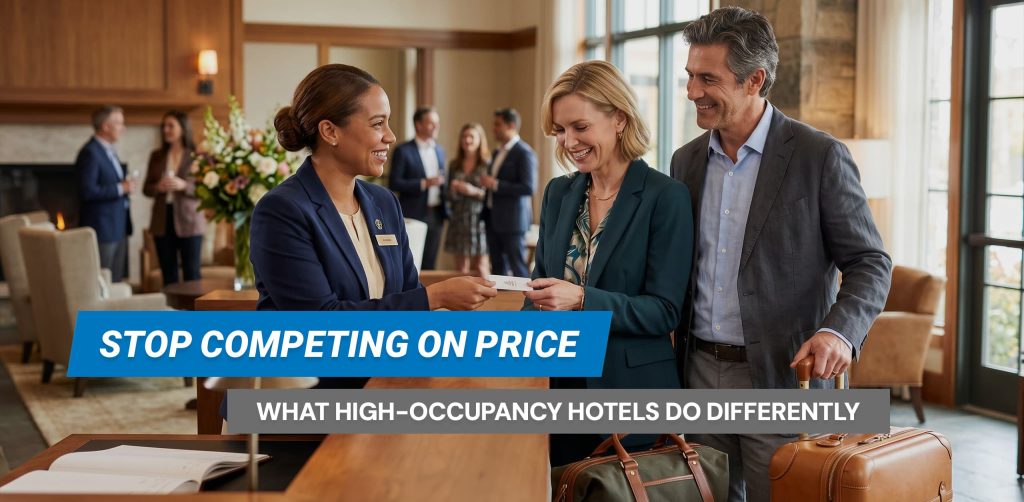
A price war is the easiest fight to start. A smart hotel occupancy strategy is the hardest one to copy.
The trap nobody talks about
Picture this. The hotel down the road drops their rate by 15%. You match it. They counter at 22% off. A reactive hotel pricing strategy means selling rooms below the cost of cleaning them by Friday, and the only winner is the OTA collecting commission on every transaction.
Sound familiar?
Price competition is the comfort food of hotel marketing. It feels like action. It feels like control. And it almost always tastes like regret on Monday morning.
Here’s the uncomfortable truth: a real hotel occupancy strategy has nothing to do with being cheaper. They’re winning because they’ve made price feel like the wrong question to ask.
What “high occupancy” actually means in 2026
Before we go further, let’s clear something up. High occupancy doesn’t mean fully booked. It means consistently full at the rate you actually want to be charging. Anyone can fill a hotel at 50% off — the skill is filling it at full price, with the right kind of guest, in a way you can repeat next month.
That’s the hotel occupancy strategy worth building — and here is how the hotels hitting it are actually doing it. And here is how the hotels hitting it are actually doing it.
Five Hotel Occupancy Strategy Moves They Do Differently
1. They sell a feeling, not a room
Walk into a beige three-star hotel and a beige four-star hotel and the only real difference is the price tag. Walk into a hotel with a clear identity — the one with the rooftop garden bar, the one with the obsessive coffee programme, the one that sponsors local artists — and price stops being the conversation.
Identity is the most underused word in hotel marketing. Every successful independent hotel we work with can answer this question in one sentence:
Who are we for, and what do they leave with that they can’t get next door?
If you can’t answer that, you’re going to compete on price whether you want to or not.
2. They protect their direct channel like it’s a vault
OTAs are useful. They’re also expensive — 15% to 25% of every booking, gone. The hotels winning on hotel direct bookings treat OTAs as a billboard, not a sales counter. The booking happens on the hotel’s own site.
Here’s how:
- A direct-only rate that’s actually visible — not buried
- A meaningful perk for booking direct: early check-in, a welcome drink, room upgrade availability
- A booking engine that loads in under two seconds and works beautifully on a phone
- A friendly, human cancellation policy
The maths is simple. Hotel direct bookings at €180 with no commission are worth more than an OTA booking at €200 with 18% commission — and the guest you booked direct is the guest you can talk to again.

3. They use data to predict, not just to report
Every hotel has data. Almost no hotel uses it.
he properties with a real hotel occupancy strategy are using AI tools to do three things their competitors aren’t:
- Forecast demand at a level of detail that used to need a full revenue team — including weather, events, flight searches, and competitor pricing signals
- Spot patterns in their own booking data: who books when, who upgrades, who cancels, who comes back
- A smart hotel pricing strategy means adjusting rates dynamically — not a human staring at a spreadsheet at 11pm
This isn’t science fiction anymore. It’s a Tuesday afternoon for a well-run hotel.
4. They start the experience before arrival
The booking confirmation email is the most boring email in hospitality. The high-occupancy hotels we work with have turned it into the first chapter of the stay.
A pre-arrival message that asks one good question — “What brings you to town?” — and uses the answer to personalise the welcome. A neighbourhood guide curated for the type of trip the guest is taking. A WhatsApp number that actually gets answered by a human in under five minutes.
Guests pay more for this. Not because it’s expensive to deliver, but because almost nobody else does it.
5. They are deliberate about who they market to
“Everyone with a wallet” is not a target audience.
The strongest hotel marketing strategies in 2026 are surprisingly narrow. A property might be designed and marketed for couples in their 30s celebrating something. Or for digital-nomad teams running a week-long offsite. Or for parents whose kids are old enough to entertain themselves but young enough to still want a pool.
Narrow doesn’t mean small. It means defensible. A hotel with a clear audience builds an Instagram feed, a website, and a guest experience that all say the same thing — and that consistency is what shows up in your occupancy numbers.

Three things to do this month
You don’t need a new agency or a new property to build a hotel occupancy strategy. You need three clear decisions. You need three clear decisions.
| 1. Write your one-sentence identity Who are you for, and what do they leave with? If your team can’t agree on the answer, that’s the most important conversation you’ll have this quarter. |
| 2. Audit your direct booking experience Open your website on a phone. Try to book a room. Time it. Count the clicks. Most hotels lose half their direct bookings somewhere in the next 60 seconds — find your leaks. |
| 3. Set up one AI-driven workflow Just one. Pick the most painful repetitive task in your week — competitor rate monitoring, review responses, demand forecasting — and let modern tools handle it. The hour you save every day is the hour you spend on the work that actually moves occupancy. |
The bigger picture
The hotels with the strongest hotel occupancy strategy at the end of this decade aren’t going to be the cheapest. They’re going to be the clearest — clear about who they are, clear about who they’re for, and clear about how they use modern tools to deliver something a price-cutter can’t copy.
Price is a number. Identity is a moat.
You decide which one you’d rather be defending.
| Want a second pair of eyes on your hotel occupancy strategy, direct-booking funnel, or positioning? Get in touch through our contact form — we’d love to hear what you’re working on. |

Schedule your free consult
Schedule a free 45-minute video call with us to discover how Atelier ATTN. (ATTENTION) can enhance your marketing efforts. Learn how our team of talented and motivated professionals in Vietnam can provide exceptional value with competitive pricing.