Your AI bill just got serious. Here’s why that’s actually a sign your business is growing — and what to do next.
It starts innocently enough. You discover AI tools for small business — ChatGPT Plus for $20 a month, maybe Grok too. Maybe Grok too. You’re experimenting, exploring, seeing what the fuss is about. The tools are impressive, the price is almost laughably low, and the productivity boost feels like a cheat code.
Then something shifts. You start relying on these tools. Your team starts relying on them. Requests get more complex, usage climbs, and one day you look at your AI spending and realize you’ve crossed a threshold. You’re no longer running a $20-a-month experiment. You’re running a $20-a-day operation — and the number keeps moving.
Here’s what most entrepreneurs do at this point: panic about the cost.
Here’s what the smartest ones do instead: treat it as the growth signal it actually is.
The $20/Month Illusion — and Why Outgrowing It Is a Good Thing
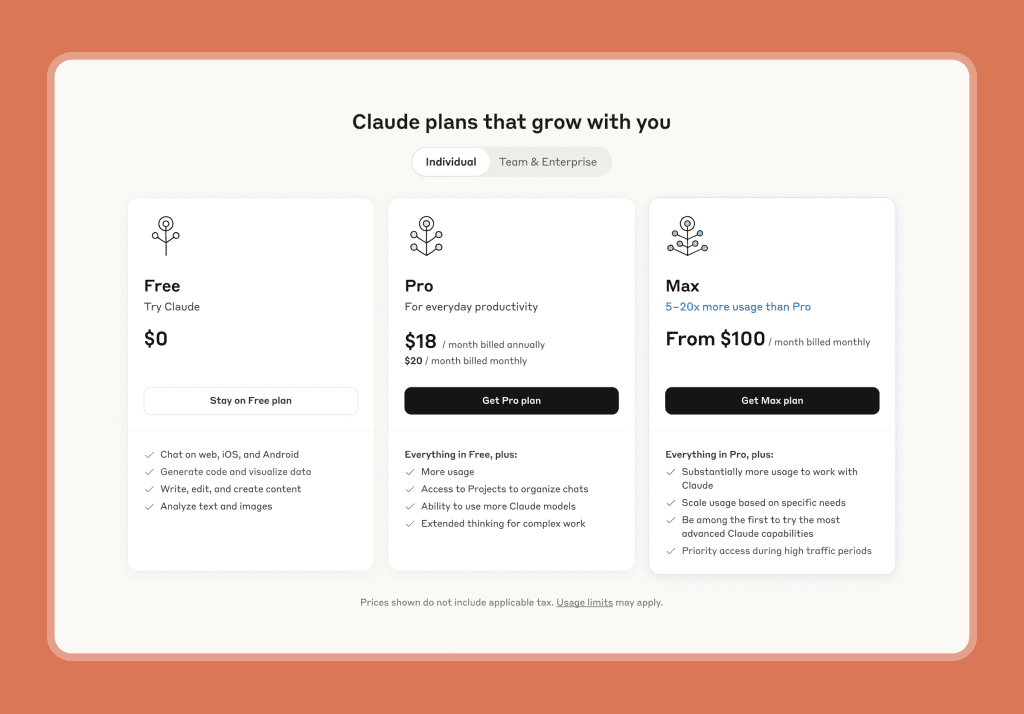
Consumer AI tools for small business are extraordinary value for individual use. At $20 a month, you’re essentially hiring a tireless research assistant, copywriter, analyst, and brainstorming partner for the price of a dinner out. No business in history has had access to leverage like this at this price point.
But consumer plans are designed for one person doing occasional tasks. The moment AI becomes genuinely embedded in how your team works — when it’s drafting client deliverables, researching markets, handling customer communications, producing content at scale — you’ve moved into a different category entirely. You’ve moved from tool to infrastructure.
| The moment AI moves from ‘useful tool’ to ‘how we actually work,’ the cost goes up. So does everything else. |
This is not a problem to solve. It’s a milestone to manage. The question is never ‘how do we spend less on AI?’ It’s ‘how do we make sure every dollar we spend on AI is returning more than a dollar in value?’

What Actually Happens When You Properly Equip Your Team
Most entrepreneurs think about the cost of AI tools for small business in isolation. They see the bill and compare it to what they used to pay. The right comparison is different: what does the output cost without AI, and what does it cost with it?
When you give your team the right AI tools — not the cheapest plan, the right one — here’s what tends to happen:
Output quality goes up, not just speed
Speed is the benefit everyone talks about. Quality is the one that actually builds businesses. A team equipped with the right AI tools for small business produces first drafts that need one round of edits instead of three. Proposals that are more thorough. Analysis that surfaces insights a solo human would have missed. The ceiling of what your team can produce rises.
Your best people get to do their best work
Think about your highest-value team members. How much of their day is spent on tasks that are important but repetitive — formatting reports, researching background information, writing first drafts of routine communications? When AI handles the mechanical 60%, they can direct 100% of their human judgment to the 40% that actually requires it. That’s AI productivity at its most powerful. That’s transformation.
| You’re not paying for AI to replace your team. You’re paying for your team to operate at a level they couldn’t reach before. |
Smaller teams can compete with bigger ones
One of the most profound shifts AI tools for small business enables is the ability to punch above your weight class. A three-person marketing team with the right AI stack can produce what a ten-person team produced five years ago. A solo founder with strong AI integration can run operations that previously required a department. Your $20-a-day investment is buying you headcount leverage — permanently.

The Token Question: AI Cost Management: How to Scale Without Micromanaging Your Team
As AI usage scales, so does a new management challenge: how do you control costs without accidentally creating the kind of friction that stops your team from using these tools effectively in the first place?
A few principles that work in practice:
- Set budgets per role, not per person. A content creator has different AI needs than an operations manager. Role-based budgets make more sense than blanket limits.
- AI cost management starts here — track usage not to punish, but to understand. High usage in a role usually means one of two things: the person is genuinely getting more done, or there’s a workflow that needs a better-structured prompt or process. Both are valuable signals.
- Make the ROI visible. When a team member uses AI to complete a task in two hours that used to take eight, document it. Build a simple internal log — this is how AI ROI becomes visible and undeniable. Over a quarter, these numbers become the clearest possible justification — to yourself and to your team — for the investment.
- Give access before restricting it. The default instinct is to limit access and expand it carefully. Consider inverting this: give your team access, watch how they use it, and then make informed decisions about where to optimize. Restriction before adoption kills momentum.
What Do You Do With the Extra Capacity?
This is the question no one asks often enough. AI productivity gives your team time and cognitive bandwidth back. What happens to it?
The answer depends entirely on your business goals — but here are the three directions that tend to create the most value:
1. Take on more clients without adding headcount
If your current team is producing 30% faster, you have 30% more capacity. For service businesses, that’s revenue you can generate without a proportional increase in payroll. This is where the ROI becomes genuinely dramatic.
2. Raise the quality bar across the board
Instead of using the extra capacity to do more of the same, use it to do the same things better. Deeper research before a client proposal. More thorough review of deliverables. More iterations on creative work. The businesses that use AI to upgrade quality rather than just speed tend to build stronger reputations and retain clients longer.
3. Invest the time in things that used to be ‘when we have time’
Every entrepreneur has a list of high-value projects that never get started because the operational load is too heavy. Developing a new service. Building out thought leadership content. Strengthening client relationships. Systematizing processes. AI returning capacity to your team is, in many ways, returning time to your strategy. Use it like it.
| 💡 A useful rule of thumb: for every hour AI saves your team, direct half toward doing more, and half toward doing better. The compound effect of that ratio over a year is significant. |

Reframing the Cost: A Simple Way to Think About It
Here is a straightforward way to pressure-test whether your AI tools for small business investment makes sense.
ChatGPT for business costs $20 a day — that’s $600 a month. If that $600 in AI tools enables one team member to produce the equivalent of 10 additional billable hours per month — at even a modest rate of $75 an hour — you’ve generated $750 in value from a $600 input. That’s a positive return before you factor in quality improvements, reduced revision cycles, faster turnaround, or the compound effect on client retention.
| The question is never whether AI costs too much. It’s whether you’ve built the workflows to extract what it’s worth. |
The entrepreneurs who will feel the cost most acutely are the ones who give their teams access to AI but don’t change how they work. The tools sit alongside old processes rather than replacing them. The cost goes up, the benefit doesn’t. That’s a workflow problem, not an AI problem — and it’s entirely solvable.
The Bottom Line
Going from $20 a month to $20 a day on AI tools for small business is not a warning sign. For most growing businesses, it’s a natural and healthy progression — the moment AI moves from experiment to engine.
The businesses that will look back on 2025 and 2026 as pivotal years will be the ones that leaned in when the cost started climbing, built the systems to extract real AI ROI, and empowered their teams to work at a level that wasn’t possible before.
The ones that pulled back will spend the next few years catching up to competitors who didn’t.
Budget for AI like you budget for talent. Because at this point, that’s exactly what it is.
| Wondering how to structure AI into your marketing strategy? Atelier ATTENTION helps entrepreneurs find the right AI tools for small business — building AI-powered marketing systems that deliver real ROI that actually deliver ROI. Let’s talk. |

Schedule your free consult
Schedule a free 45-minute video call with us to discover how Atelier ATTN. (ATTENTION) can enhance your marketing efforts. Learn how our team of talented and motivated professionals in Vietnam can provide exceptional value with competitive pricing.